As AI-generated images become more realistic, investigators, courts, and journalists face a practical question: can science determine whether an image was captured by a camera or produced by a generative model?
The question behind the debate
On October 15, 2026, OpenAI policy counsel Shira Anderson took part in a deepfakes panel before the U.S. Judicial Conference's Advisory Committee on Evidence Rules. Reuters reported her position in direct terms:
"AI images are only getting better, and I do not think that there will be a scientific way going forward to detect them."
The concern deserves attention. Modern generative systems produce convincing images and video, while familiar visual defects such as malformed hands or inconsistent shadows are becoming less dependable.
The available evidence does not support the broader proposition that scientific detection will become impossible. A method that cannot detect every AI-generated image is not the same as a method with no scientific basis. Digital forensics depends on that distinction, and recent research by forensic scientist Richard Matthews shows why.
What the research found
Matthews addressed the reported claim in an October 21 article. His response draws on a peer-reviewed study published online in the Australian Journal of Forensic Sciences in April 2026. The study tested whether selected camera photographs and DALL·E-generated images differ in measurable ways.
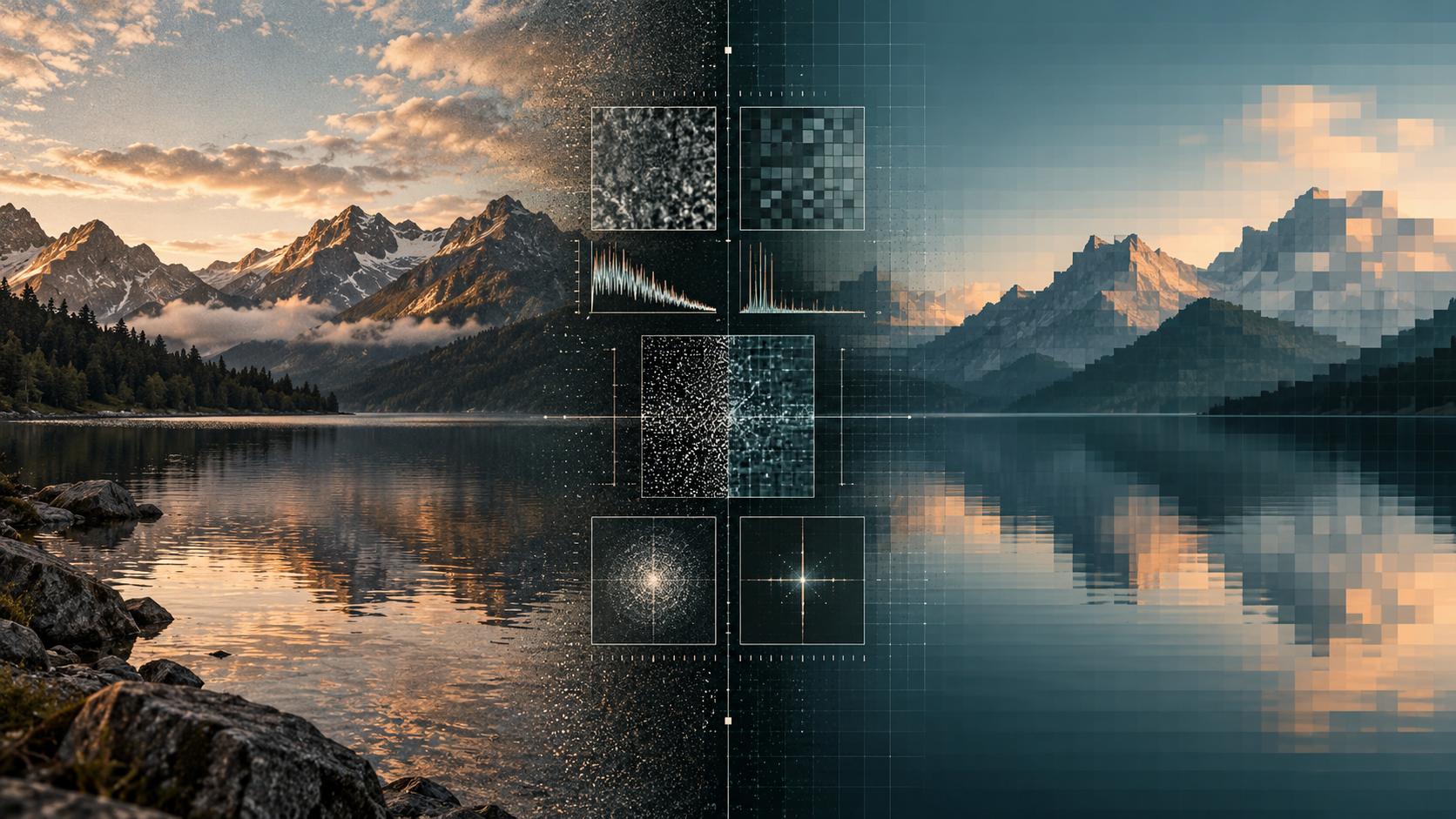
It did not rely on strange fingers, distorted objects, or other visible defects. It examined aspects of image production. When light reaches a camera sensor, the sensor converts it into electrical signals that are processed into an image. That process can leave measurable variation, including forms of noise. A generative model creates image content computationally without capturing light from the depicted scene.
Matthews compared camera photographs from the Dresden Image Database with DALL·E-generated images. He applied wavelet denoising to grayscale luminance data, extracted noise residues, and evaluated variance, skewness, and kurtosis. A multivariate kernel density method was then used to assess separation between the two groups.
Across 100 randomly sampled runs, the Results section reported:
- Mean ROC AUC of 0.998. This measures how well the method separated the tested groups across decision thresholds.
- Mean classification accuracy of 98.5%. This is the average proportion classified correctly under the experiment's conditions.
The paper contains a reporting discrepancy that should not be ignored. Its abstract gives an accuracy of 0.998, while the Results section and Matthews' later explanation give a mean accuracy of 0.985 across the 100 runs. I use the more conservative Results figure here. The discrepancy does not alter the reported AUC, but it should be corrected or clarified in the publication record.
These findings show strong performance within the tested image populations. They do not establish that the method will correctly classify 98.5 per cent of AI-generated images encountered in casework. Cameras, generators, editing, and compression may differ materially from the study conditions.
The experiment also does not establish that camera capture alone caused the separation. Dataset construction, processing, or other uncontrolled characteristics could have contributed. Further testing with unfamiliar sources is needed to distinguish those explanations.
What the findings do and do not establish
Reading this study as proof that OpenAI is simply wrong would exceed the evidence.
The reported experiment shows that a scientific method distinguished selected camera photographs from selected DALL·E-generated images with very high performance under defined conditions. It does not establish that every AI-generated image carries a detectable signature, that the same method will work against future generators, or that its error rates transfer to operational casework.
This is also one peer-reviewed study, not an independent replication programme. Matthews authored both the journal paper and the later RHEM Labs explanation discussed here. Independent testing across laboratories, image sources, and processing conditions remains necessary.
Matthews acknowledges important limits. Screenshots, recompression, editing, unfamiliar cameras, and unfamiliar generators remain open problems. Those limits narrow the finding without erasing it. Some synthetic images can be distinguished through measurable characteristics. Other files may preserve too little reliable information to support a conclusion about origin. Both statements can be true.
Why OpenAI's concern deserves weight
One promising experiment is not a reason to dismiss the warning. Image generation is developing quickly. A method that works against one model family may perform poorly against another or become obsolete as generators change.
What happens after creation adds a second problem. Resizing, compression, editing, platform uploads, and screenshots can change or remove the characteristics an examiner relies on. Some images combine camera photographs with generated content. Others are fully synthetic but are later photographed from a screen with a physical camera.
That last example separates questions that are often treated as one. Suppose an investigator receives a photograph of a monitor displaying an AI-generated face. The file may contain genuine camera-sensor characteristics because a camera captured the monitor, yet the face on the screen never existed. A method that supports camera capture does not establish that the depicted scene was real.
The investigator must define the proposition:
- Was this file produced by a camera?
- Did the depicted scene exist?
- Was part of the image altered or generated?
- Did the image originate from a particular system?
Each question may require different evidence. If Anderson meant that no universal method will reliably identify every future AI-generated image, that is a defensible concern. It should not be expanded into a claim that scientific examination cannot provide useful evidence about image origin.
Detection is one part of the investigation
Public discussion often asks whether a detector can label an image real or fake. A forensic investigation needs more than that label.
Consider an image said to show an employee entering a restricted office after hours. A detector reports that the image is likely AI-generated. That result alone establishes very little.
The investigator needs to know where the image came from, whether the original file is available, and how it was handled. Camera-system records, metadata, access-control logs, timestamps, witness accounts, and other recordings may support or contradict the allegation. The detector also requires scrutiny. Was it tested on comparable images? What errors does it make? Could compression or editing have affected the output?
A detector's output can be an investigative lead. Whether it can support a formal conclusion depends on the method's validation and the circumstances of the case. The output is an observation requiring interpretation, not proof of authenticity or fabrication.
The same constraint appears throughout digital forensics. A timestamp does not independently establish when an event occurred. An IP address does not identify the person who performed an action. A file hash establishes that two sets of bytes match, not that the information inside them is true. Each observation addresses a defined proposition. Problems begin when an examiner asks it to support more.
Provenance helps, but it is not the whole answer
Provenance records where digital content came from and how it was handled or changed. C2PA Content Credentials can bind signed claims and assertions to an asset. The C2PA specification is careful about the limit: validation can establish that assertions are associated with the asset, correctly formed, and free from tampering. It does not decide whether the provenance information is good, bad, or substantively true.
When a trusted system provides a valid claim that an image was AI-generated, that record can support the image's documented history. The reverse does not follow. Missing provenance does not prove camera capture. Metadata can be stripped, credentials may not survive a workflow, and some systems provide no compatible provenance.
Valid records still require interpretation. They may support claims about a file's recorded history without establishing that the depicted events occurred.
Provenance and forensic examination approach origin from different directions. Neither provides a universal answer. A stronger assessment usually draws on independent evidence that addresses the same proposition.
What makes a conclusion defensible
The objective is to determine what the evidence can reasonably establish, not to produce the most confident label. A high confidence score from a tool does not meet that standard by itself. Before relying on an AI-image detection method, an investigator should be able to answer six questions.
- What exactly are we trying to establish? Whether a camera produced the file is different from whether its contents represent a real event.
- What evidence was examined? An original file, downloaded copy, and screenshot preserve different information. Source and handling history constrain the conclusion.
- How was the method tested? Performance on one image set does not transfer automatically to unfamiliar material. Validation should reflect the intended conditions of use.
- What errors are possible? A false positive labels genuine material as synthetic. A false negative accepts synthetic material as genuine. Both have consequences.
- What else could explain the findings? A characteristic may arise from generation, editing, compression, in-camera processing, or dataset construction.
- How strong is the conclusion? The evidence may strongly support one explanation, offer limited support, or remain insufficient.
An inconclusive result is not a failed examination. It may be the most defensible finding the evidence permits.
What this means for courts and investigators
Errors in either direction carry legal and investigative consequences. An authentic image challenged as synthetic can weaken legitimate evidence. A fabricated image can be accepted because it looks convincing or because a detector missed it. A confident tool output justifies neither outcome.
Courts need to understand the basis of an expert opinion, the reliability of the method, and the limitations affecting its application. Internal investigations, fraud examinations, and cybersecurity cases require the same discipline whenever digital evidence informs a consequential decision.
As synthetic content improves, investigators will need stronger preservation practices, validation against relevant populations, and clearer reporting of uncertainty. A method does not become invalid because it cannot answer every question. Its value depends on whether it reliably addresses the proposition for which it was tested.
Where I stand
Detecting AI-generated images will become harder. Some methods will become obsolete. New generators may remove or imitate characteristics used today, and some files will preserve too little information to support a reliable conclusion.
The evidence does not support a blanket conclusion that scientific detection will become impossible. Matthews' experiment reports measurable differences between particular camera photographs and particular DALL·E-generated images. How far those findings generalize remains a question for further testing. That work may show that some approaches transfer across systems while others are weaker than they first appeared. Either result would improve what examiners can defensibly say.
Forensic science does not promise certainty in every file. It tests defined propositions, reports the strength and limits of the findings, and revises conclusions when better evidence arrives. The standard is not whether a method eliminates uncertainty. It is whether the method has been tested well enough to support a conclusion under the conditions in which it is used.
Sources and further reading
- Reuters (October 15, 2026), "OpenAI, Meta caution US judiciary about risk of 'deepfake' evidence".
- U.S. Judicial Conference, Advisory Committee on Evidence Rules (October 15, 2026), agenda book and deepfakes panel materials.
- Matthews, R. (2026), "Challenges in authenticating synthetic media: forensic insights from 6,000 DALL·E-generated images", Australian Journal of Forensic Sciences, published online April 6, 2026.
- Matthews, R., RHEM Labs (October 21, 2026), "OpenAI's 'no scientific way' claim on AI image detection".
- RHEM Labs (October 8, 2026), "AI-Generated Images as Evidence: Authentication, Provenance and Forensic Examination".
- Coalition for Content Provenance and Authenticity, C2PA Technical Specification, version 2.2.